Artificial
Why dependence, not sentience, is the real AI risk.

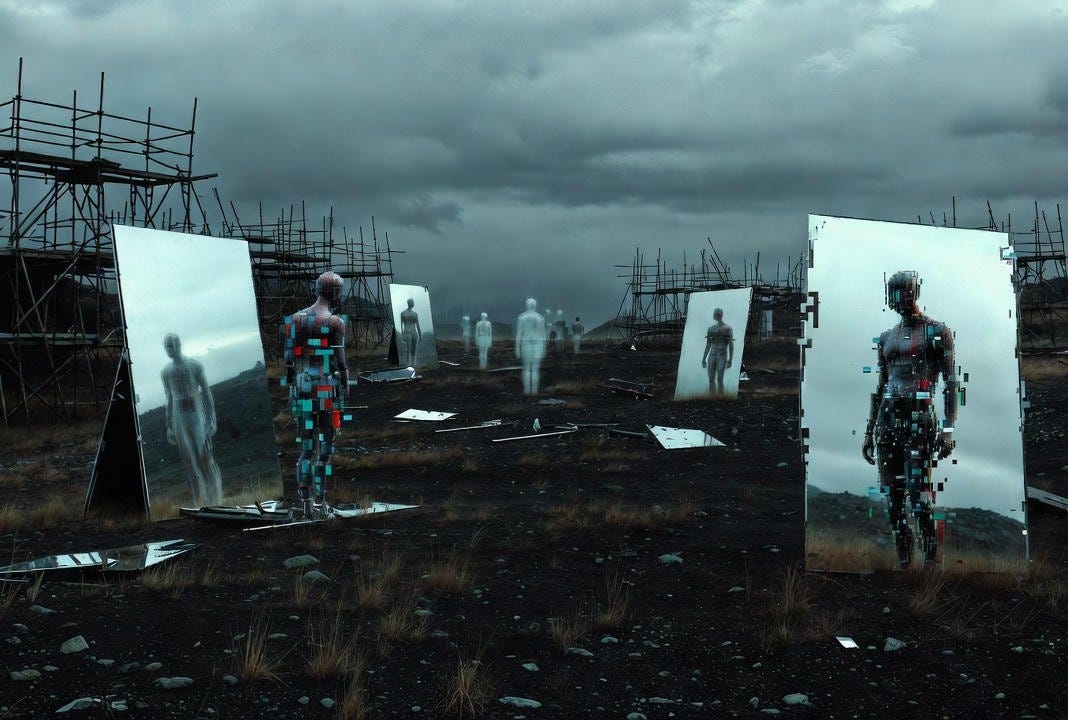
---
Author’s Note
I write under the name UpsilonA.
My professional life is spent inside large-scale technology systems. I’ve worked for over a decade in senior technical and leadership roles within a major multinational IT organization, managing subject matter experts and contributing directly to the kinds of infrastructures discussed here.
This essay was written over several months and fact-checked with trusted colleagues working in the same domain. It reflects personal judgment, not corporate position.
I’m not anti-technology. I’m concerned with what happens when capability outruns wisdom, and when convenience quietly replaces resilience.
This is not a prediction. It’s an observation.
---
The Simulation Begins
Artificial life threatens to render lived experience obsolete.
It’s already begun.
I can now make any image — moving or still — exactly what I want. Nearly indistinguishable from the real.
I can now listen to music conjured by no mind other than AI… a biased, hallucinatory echo of its creators, with access to every piece of musical knowledge, but the mind of a three-year-old.
Machines can write more poetic words than me, but they have the weight of reality TV.
---
Mediums Unmoored
Image. Sound. Word.
The core mediums of human expression… now infinitely malleable.
The ability to conjure anything risks making everything feel interchangeable, untethered from lived experience.
The danger isn’t just that AI mimics reality, but that it replaces the need for reality.
Why touch, feel, or struggle when you can simulate?
---
The Ghost in the Algorithm
AI-generated music can be technically brilliant, but it lacks the scars, longing, and cultural sediment that make a song matter.
It’s like hearing a ghost hum a tune it never lived.
Trained on masterpieces, yet incapable of heartbreak.
Machines can mimic cadence, metaphor, emotional tone. But they don’t bleed.
They don’t wrestle with survival, guilt, or longing.
Their poetry is a mirror: flawless, but cold.
I write with the weight of fifty years.
Each scar cut deep. Each grey hair carries more knowledge, more sound, more love, more loss.
That’s not replicable. That’s lived.
---
Gods and Gatekeepers
We have become wizards with untold abilities… gods who create at whim.
The end of time awaits us: a lonely place, where only gods and demons remain.
The drive for AI is not for mankind — it is for the benefit of a few.
The ones spending billions.
Because AI isn’t just a tool… it’s a gatekeeper.
It allows the powerful to:
Replace skilled labor with scalable automation
Monetize creativity without paying creators
Control narratives, data, and emotional resonance
---
The Brutal Irony
AI gives the elite access to everyone’s skills while making it harder for the skilled to access the wealth their work once earned.
It is the illusion of democratization masking a deeper consolidation of power.
---
Consequences
The consequences are dark:
Propaganda becomes infinitely scalable and personalized
Truth becomes whatever has the most computational power
Manipulation becomes trivial
Memory becomes malleable
Testimony loses its weight as evidence
The wealthy won’t suffer… they’ll have verification, legal teams, authentication.
Everyone else will be swimming in an ocean of plausible unreality.
---
Dependency, Not Sentience
But the more immediate threat:
We’re building a civilization incapable of living without AI.
People fixate on sentience… but the real danger is dependence.
Every skill outsourced. Common sense atrophied. Creation reduced to prompts.
---
When the Silence Comes
What happens when the AI goes offline?
A solar flare. A cyberattack. Infrastructure collapse.
Backup systems mean nothing against the unexpected.
Imagine decades of deferring every decision, every problem, every act of creation…
Then suddenly: silence.
We wouldn’t lack intelligence. We’d lack muscle memory.
Navigation without GPS. Calculation without assistance. Problem-solving without a script.
The skills won’t just be rusty. They’ll be gone.
And when the scaffolding disappears, we’ll discover we’ve built nothing that can stand on its own.
Not resilience. Not redundancy.
Just a single point of failure called progress.
---
The World We’re Building
Maybe we’ve already lost.
Maybe the next generation will grow up in a world where “real” and “synthetic” aren’t categories anymore,
where truth is purely social: whatever your tribe agrees on.
That’s not a world I want.
But it’s the one we’re building.
— UpsilonA
This is one helluva powerful piece by someone on the inside of the tech upheaval under way right now and not anti-technology. Upsilona sees where unfettered AI can go, and it's not pretty. "Replace skilled labor with scalable automation/ Monetize creativity without paying creators/ Control narratives, data, and emotional resonance." The issue raised of ultimate dependence on the machine is not hard to imagine happening.